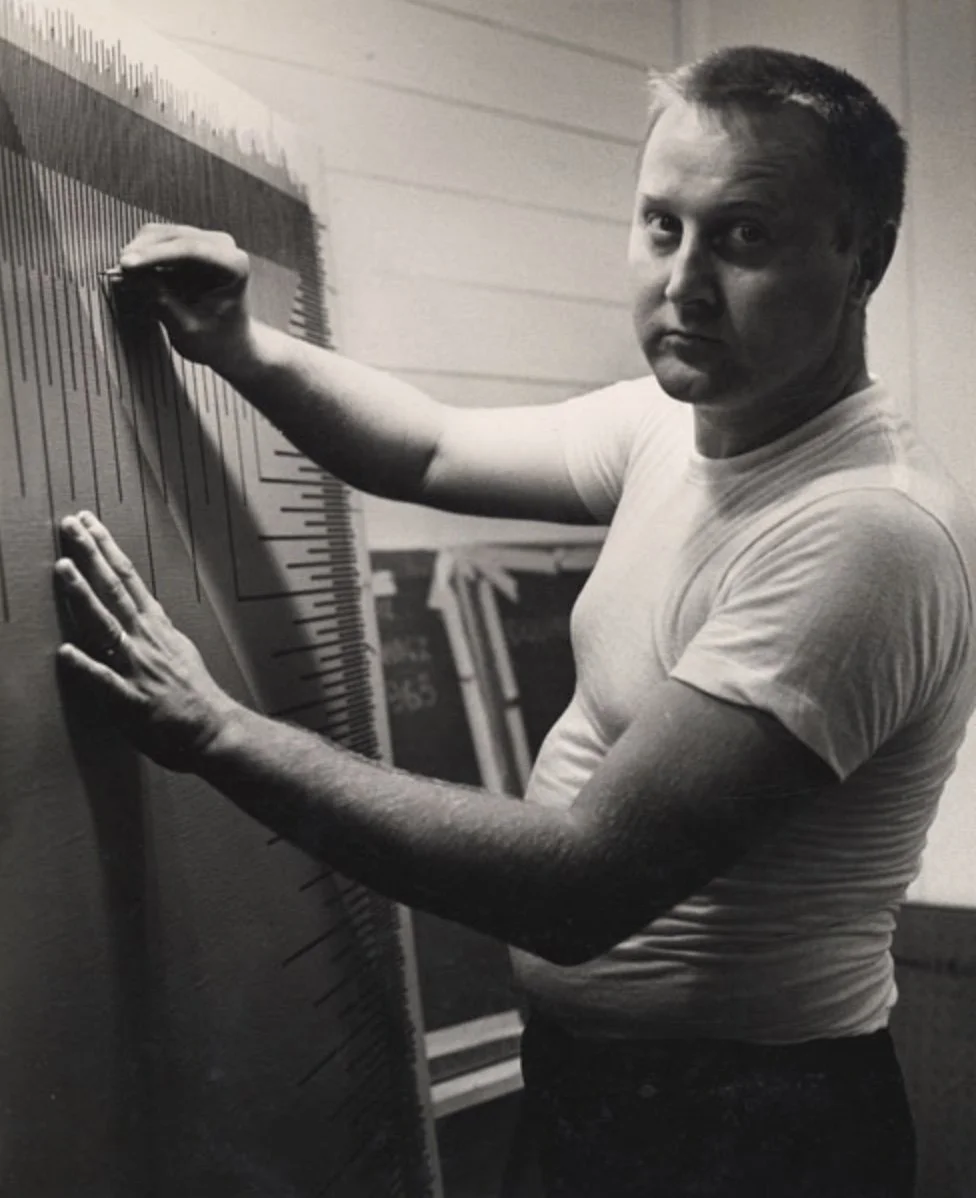


Richard Anuszkiewicz was an American painter, printmaker and sculptor known as a leading figure of the Op Art movement. He was born in Erie, Pennsylvania, in 1930 to Polish immigrant parents and studied at the Cleveland Institute of Art from 1948 to 1953 before earning an MFA at Yale University School of Art, where he studied under Josef Albers.
Anuszkiewicz developed a geometric style focused on the optical effects of colour, light and form. Influenced by Albers and his experiments with colour relationships, he created paintings using intense complementary colours and repeated geometric structures, often based on nested squares. His work explored how colour and light could appear to shift, glow and change when placed in close proximity.
He became one of the leading figures of Op Art in the late 1960s and 1970s, alongside artists such as Victor Vasarely and Bridget Riley. His work was exhibited internationally, including at the Venice Biennale, Florence Biennale and Documenta, as well as major American museums and galleries. In 1964, Life magazine described him as one of the “new wizards of Op.”
Anuszkiewicz received numerous awards and grants throughout his career, including the Cleveland Arts Prize, Lee Krasner Award and Lorenzo dei Medici Career Award. He was elected to the National Academy of Design in 1992 and became a full member in 1994.
His work is held in the permanent collections of major institutions including the Museum of Modern Art, Metropolitan Museum of Art, Guggenheim Museum, Whitney Museum of American Art, Art Institute of Chicago and Cleveland Museum of Art. He died in 2020.