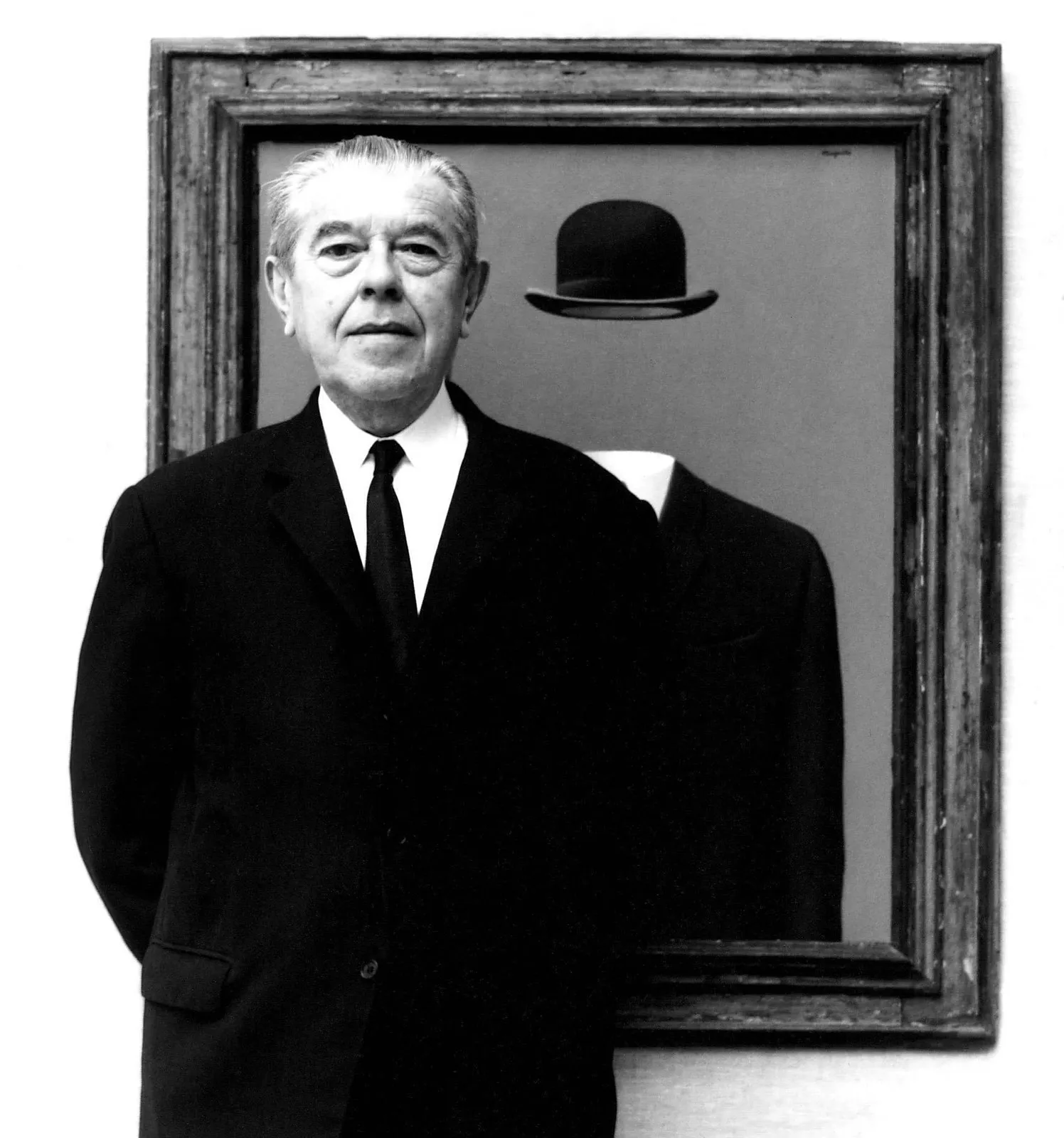

René Magritte was a Belgian Surrealist painter known for placing familiar objects in unfamiliar contexts to question the relationship between reality, representation and perception. Born in Lessines, Belgium, in 1898, he began drawing lessons in 1910 and studied at the Académie Royale des Beaux-Arts in Brussels from 1916 to 1918. His early work was influenced by Futurism and Cubism before he developed the distinctive representational Surrealism for which he became known.
After working as a draughtsman in a wallpaper factory and as a poster and advertising designer, Magritte was able to paint full-time from 1926. That year he produced his first Surrealist painting, The Lost Jockey. Following his first solo exhibition in Brussels in 1927, he moved to Paris, where he became involved with André Breton and the Surrealist group. During this period he developed an illusionistic, dream-like approach built around the unexpected combination of ordinary objects and images.
Magritte's paintings often transform familiar things into strange or contradictory situations. In The Treachery of Images, for example, a realistically painted pipe is accompanied by the words “Ceci n'est pas une pipe” (“This is not a pipe”), drawing attention to the difference between an object and its representation. Other major works, including The Lovers, The Human Condition, The Son of Man, Golconda and The Empire of Light, similarly explore the tension between what is seen and what is understood. His paintings frequently place ordinary objects in unexpected settings, creating images that Magritte described as evoking mystery rather than offering fixed meanings.
Magritte returned to Brussels in 1930 and continued working in advertising alongside his painting. He held his first solo exhibition in the United States at the Julien Levy Gallery in New York in 1936, followed by an exhibition in London in 1938. During the German occupation of Belgium, he remained in Brussels and briefly adopted a more colourful, painterly style in response to the circumstances of the war. After the war, he returned to the Surrealist style and themes of his earlier work.
Magritte's influence grew considerably during the 1960s, when his imagery became increasingly familiar to a wider public. His work subsequently influenced Pop, Minimalist and Conceptual artists, while his imagery was adapted in advertising, album covers, film and popular culture. Major retrospective exhibitions were held at the Museum of Modern Art in New York, the Metropolitan Museum of Art and the Centre Pompidou. The Magritte Museum opened in Brussels in 2009, housing around 200 original paintings, drawings and sculptures.
Magritte died in Brussels in 1967, aged 68. His work remains central to the history of Surrealism, particularly for its sustained examination of images, language and the boundary between reality and representation.